
MAGAZINES
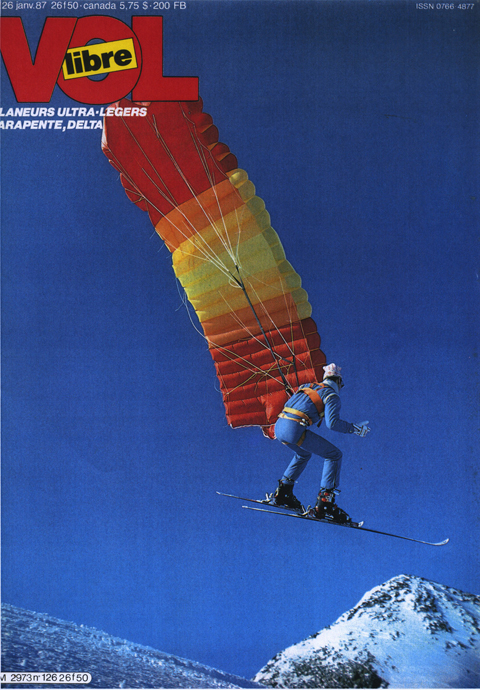
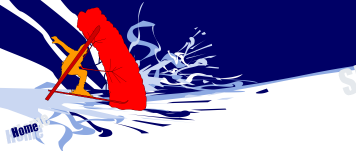
"Vol Libre", Canada, 26. Januar 1987
"At that time the title picture went around the world..."
.......................................................................
AND THE WORLD COULD FLY
The birth and growth of hang gliding and paragliding
Editors: Stéphane Malbos and Noell Whittall
Paragliding: the forerunners
Ski-kite to paraglider: Dieter Strasilla
German Dieter Strasilla was a pioneer of two sports that were to become popular at the end of the twentieth Century: snow-kiting and paragliding. His main preoccupation was with developing steerable traction kites. While working in the USA in 1960, he started 'ski-sailing' on the dunes of White Sands, New Mexico, using old snow-skis and adapted round parachutes. Back in Europe in 1961 he continued to refine his technique and the canopies, until, under wind power alone, he could ascend significant mountains near his home-town of Berchtesgaden in Germany, and in Switzerland. He told of kiting up the Aletsch Glacier and then flying the canopy down to Lauterbrunnen in the early 1970s, quite a regulär activity, apparently. The problem of launching on skis but then having to land on grass in the Valleys concerned him, but he solved it by letting the skis land first on a ten-metre cord or even releasing them under their own small parachute!
Dieter and his brother made many flights, but were in constant fear of getting in trouble with the authorities in Germany, because at that time his sort of flying was technically illegal. Perhaps if he had been able to be more open about it, enthusiasts would have been drawn to paragliding several years sooner.
.......................................................................
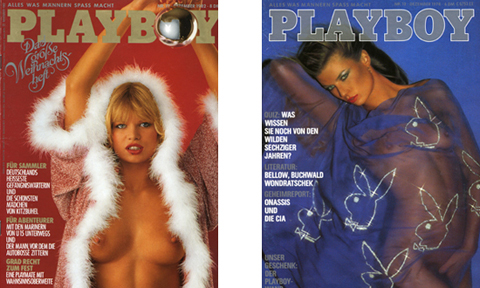
Skywing and the girls of Kitzbühel
Carmen von Garnier (top left and below) looking up. On the mountain via parachute in Kitz - "crazy place, action non-stop, I like it" and as a soon-to-be pop star ("freaked-out stuff) on her way to the top ten in Munich.
Playboy, Dezember 1982
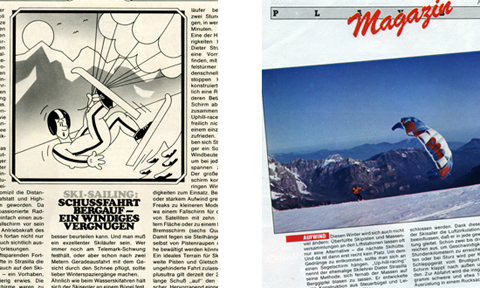

AND THAT's HOW IT ALL BEGAN:
Schweizer Illustrierte, 8.11.76
Strasilla made his first experiments with a parachute and a bike in Texas (1960)

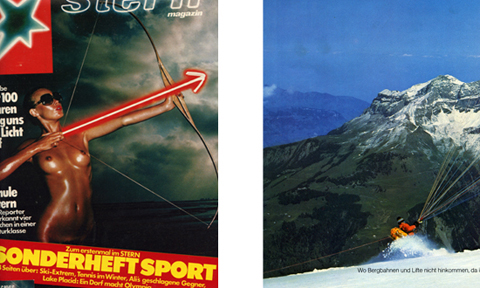
STERN, 1976, PARTICULARS
Dieter Strasilla, 33, graduate chemist from Freiburg has invented "parachute sailing on skies" (Strasilla). Thanks to the new type of sport skiers can have themselves pulled along the trail, especially uphill and also against the wind if going zigzag. The technique demands skiing skills and stability on the slats. Experts can also risk capers if they know how to safely touch down. When there is no snow in our region, Strasilla does his training in the high mountains of Switzerland, mostly at 3240m high Titlis.
At Monte Rosa close to Zermatt where other people set speed records in downhill skiing, the roving inventor has established a record in going uphill: "I did this route uphill with my brother Udo in tow - in three minutes! A mountaineer needs an hour when he climbs
up."
SPIEGEL 1976, PRISM
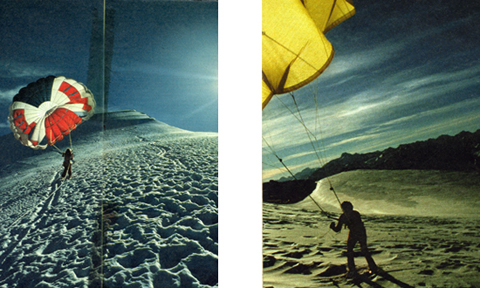
SKISPORTS WITH A PARACHUTE AND A PROPELLER
The Soviets try engine power. A winter sports athlete from West Germany uses the power of the wind. Aviation accessory is supposed to make skiers faster in any case. Allegedly, the backpack motor (which drives an airscrew) is able to push a cross-country-skier across flat terrain with a speed of up to 80 km/h. In contrast, Dieter Strasilla from Freiburg has himself pulled uphill by a special parachute. The chute (developed by NASA) has a sophisticated systems of shroud lines and steering tethers. Strasilla managed to cross 27 km long Aletsch Glacier which stretches up to Jungfraujoch and went up the skislope at Breithornplateau in three minutes - regular time for the ascent: one hour.
WHITE STONE IN THE HISTORY OF PARAGLIDERS
by Francois Perraudin
Oberengadin in the winter of 1972/73: A spectacular skier is sailing back and forth on Lake Maloja, pulled by a round parachute-like sail. A whistling wind is going though the fabric. A cross-country skier is running after the first guy like a madman. After many traverse rides the excited skisailor finally comes to a stop. That winterday an amazing tandem is created: there is 30 year old chemist Dr. Dieter Strasilla at the sail and there is Andrea Kuhn from Engadin, his future test pilot, only 17 years old at the time and still on cross-country skis.
20 years later I'm sitting with the two of them at Philippe Bernard's (a.k.a. Super Max's) place in Verbier. Yesterday we watched "Headwind", a poetic portrayal of the first "crazy flyer" by Palino. We had been invited by Didier Favre, another kite artist and pioneer of Cap 444. I never had a stronger feeling than on this weekend, unter the wings of Otto Lilienthal's guardian angel, that the process of development does not only need scientists, but also these kind of connoisseurs of life to create its "white stones".
Dieter Strasilla and Andrea Kuhn came here especially to give an old chute to Didier Favre, founder of the New Swiss Museum of Free Flight. The soft fabric was made in 1973 and when Andrea tells be about his own age, I know what this is all about: "36, but actually I'm as old as paragliding, so I'm 20" Paragliding, the easy way of gliding with the help of coated, slightly tighter fabric was not invented in the French town of Mieussy in 1985 as it is often stated in professional journals. Strictly speaking, Dieter Strasilla and Andrea Kuhn do not demand to be recognised as "the fathers of paragliding". They would just like to complete its history with their contribution. When both pioneers hoist their old chute in the dynamic upwind of Croix de Coeur the next morning, when they perform their capers in front of modern paragliders who are completly amazed, and when Dieter does two flights reaching 400m, I am seized by the fever of a hobby historian.
DR. STRASILLA STARTS WINDSAILING IN 1961
Long before he meets Andrea Kuhn Dieter Strasilla is concerned with windsailing. Already in 1961 he sails up the sand dunes of the White Sands Desert in New Mexico with the help of the pulling force of a round parachute device he has constructed himself. And there is already the secret idea of being able to fly down one day. Back in Europe in 1964, he tries using skies. He is pulled up snow covered slopes in traverse by the amazing power of the wind. His brother Udo who is a phycicist at NASA sends him two satellite recovery parachutes. Unfortuately they proof to be too shiftless and heavy. Every summer Strasilla sketches new designs, cuts and sews new chutes, impatiently waiting for the test runs in wintertime. Step by step the sail changes from a round design to a flat design derived from that of the new mattress parachute, from a soft and light fabric to a coated, tighter one. In 1965 he uses spinnaker fabric. During the winter test runs the upwind on the slopes sometimes gets strong enough to allow for small jumps. Having just met his first student Andrea Kuhn, Strasialla creates the "9 cell Skywing" in 1973. Andrea piloted this model once again for Gleitschschirm on this golden weekend in June 1993. It is a foursquare chute with a supposed glide ratio of 1/2,5 to 1/3 and a size of 32m2; "Skywing" it is called; "sky" to suggest flying, "wing" to suggest sailing.
ANDREA KUHN'S CURRENT FAVORITE TOOL
Today the name is connected to Andrea's favorite tool, the Skywing system. An aluminum rod with central suspension that allows the chute to always turn in the wind regardless of the movements of the pilot. This is a major advantage when facing strong winds.
So what happened back then when the upwind got so strong that the chute drove the pilot high up into the air when skisailing? At the beginning, the built-in release system was used for resasons of security. Gradually, the two pioneers dared to go higher and stay up in the air for a longer period, though. A safety rope connected them to the ground; eventually this last connecting link disappeared (body rope?). The two pioneers did not want to go public with their experiments they certainly did not think about commercializing their products: If the capers were performed too high above the ground the Federal Agency of Aviation could have imposed a strict ban.
Chemist Strasilla did think about the protection of his inventions, though. He applied for a patent at the patent office in Munich five times; among other things he got a patent for his 1976 round parachute. In the meantime Andrea Kuhn had already received the 11 cell model, a surface prototype built by Dieter: it was 40 m2 in size and had a reliable glide ratio of 1/3. As a precaution, this chute was labelled a skysailing device in 1978: "Flying was more of a bonus and we were afraid of a ban on flying" Strasilla remembers. Those who have already seen Kuhn's peculiar performance on a screen know that the bonus feature would soon become the main feature.
AN IMPRESSIVE LIST OF ADVENTURES
In 1976 Dieter Strasilla and Andrea Kuhn find an ideal training slop high up in the mountains: the peak of Piz Corvatsch, 3451 a.s.l., easily accessible by cable car. Gradually, they develop a dynamic launch off the slope which is performed going uphill in traverse as soon as the wind is strong enough. In the evening, Strasialla and Kuhn diligently analyze the steepness of the mountain on a map: Will a glide ratio of 1/3 be enough to fly in the direction of Val Roseg? Dieter Strasilla chooses practical experience over theory. One day he takes off: barely avoiding the ledge, not quite reaching the bottom of the valley. The performance of Andrea's parachute is not suffient. He always receives the smaller, worn out chutes from Dieter. Very soon Andrea's flying skills will compensate for the disadvantage in material, though, and when Dieter flies from the peak of Piz Corvatsch towards Sils, Andrea is with him: 1700m difference in altitude! Is there a paraglider who has not dreamed about a high altitude flight like this in the middle of the high mountains?
THE FISH IS HOOKED
Dieter Strasilla subsequently combines his art of sailing uphill with the ecstacy of flying down. In 1980, he sails up Aletsch Glacier to Jungfraujoch on skis, then takes off in the direction of the Bernese Oberland. The next destination is located in France. In 1981, he sails up Vallee Blanche, waits for a favorable wind direction on the peak of Aiguille du Midi and flies towards Chamonix the next day. The times of secretive experiments away from the public eye are over: Famous magazines like "Die Schweizer Illustrierte", "Bunte" oder "Paris Match" do reports on the daredevil gliding and flying artists. Dieter and Andrea try to commercialize their art: Andrea Kuhn has a go at being a flight instructor in his windsurfing school in Oberengadin. Dieter Strasilla has his chutes produced in Italy, starting in 1981. Few people are interested in the gear, though. Apparently, the moment the new type of sport is able to find general approval has not yet come. In 1984, Hugo Stamm of the "Schweizerischer Tagesanzeiger" contacts the Federal Agengy Of Aviation asking them if they had already heard about the new flying device. Fritz Bigler, inspector for engingeinoperative flight, has a negative answer. He expects the new chute to be covered by the hang-glider regulations, though and points out it would be easiest if the paragliding schools joined the Swiss Hang-Glider Association.
THE CONNECTION TO OUR YOUNG HISTORY OF PARAGLIDING
The pioneers have played their part, soon paragliding is a public thing - in France. This country has always shown a love for new types of sport. Strasilla writes: "France, that's where people love innovations and where everything that is not prohibited is permitted. In Germany, in contrast, everything that is not permitted is prohibited." And when Andrea Kuhn wins a duration flight at the Saleve near Geneva, when he is able to compare the performance of this old '78 chute to Laurent de Kalbermatten's brandnew "Randonneuse", we have managed to make the connection to our young history of paragliding. I personally put the pen down on the table and reach for the most advanced of the present to once again feel the lightness of being in its most simple way.
19 GLEITSCHIRM
AKROBATICS
FISCHER MAGAZIN
There is a new answer to the old controversial question wether flying or skiing is more beautiful: It is skiflying. If climbing waterfalls is the latest challenge for alpinists, skisailing is the latest one for skiacrobats. For his new type of sport, "ski sailing and flying" German adventurer Dieter Strasilla from Weil am Rhein is looking for super light skis that are about 2m in length and come with bindings that are easy to open when one is dangling up in the air. "When launching off frozen peaks and touching down in the valley I want to drop them with a mini parachute", Strasilla says in a written inquiry. The air composite core, the leightweight core by Fischer, is likely to easily meet this wish. Skiing, flying - or both at the same time.
Photo by Klaus Hertwig
CIBA GEIGY JOURNAL, 03/1986
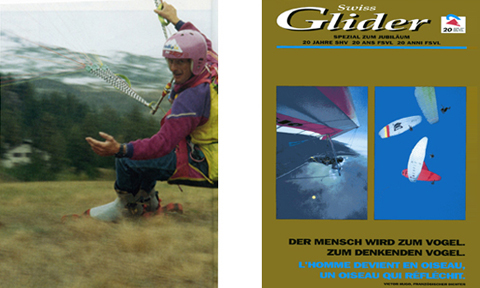
He flies through the air with the greatest of ease It's called para-ski-sailing, and Dieter Strasilla of Weil am Rhein
near Basel takes to the air on his patented Sky Wing. A vital component
of the buoyant appendage is the canopy release, consisting of a UreolÆ
foam core and metal parts held together without bolts or rivets by carbon
and glass fibres laid up with Araldite epoxy. The canopy release links a 40-square-metre sports parachute to a harness
and can support loads of more than two metric tons. The release acts
simultaneously as a pivot joint, steering rod, suspension line snap
hook, and quick-release safety. It positions all controls at convenient
chest level, enabling a skier to sail uphill and fly downhill. At the Premiere Coupe de Finesse parachute jumping competitions held
at Saleve last March, Andrea Kuhn won the drop rate contest using a
Sky Wing canopy. Mr. Kuhn, who has achieved speeds in excess of 100
km/h (60 mph) on the level, is operating the first Swiss para-ski-sailing
school in Sils Maria, in the Grisons. It's a summer sport too: waterskiers
can per- form similar up-and-down feats.
Ciba Geigy Journal 3/86
Printed in Switzerland
GLEITSCHIRM 9, September 1992
Table of contents After many traverse rides the excited skisailor finally comes to a stop. That winterday an amazing tandem is created: there is 30 year old chemist Dr. Dieter Strasilla at the sail and there is Andrea Kuhn from Engadin, his future test pilot, only 17 years old at the time and still on cross-country skis. It was Dr. Dieter Strasilla and Andrea Kuhn. In 1973 the 9-cell Skywing is created. Recently, Andrea Kuhn flew the golden wing again for 'Gleitschirm'. A unique photo report.
HOMME OISEAU
La mode du paraski va atteindre les Sommets francais
Le skieur d¥espace est un homme-oiseau Avec le paraski, les skieurs
ont trouve le plus fantastique des remonte-pentes:gratuit, silencieux
et capable, au gre du vent, de vous emmener vers les plus inaccessibles
sommets d¥ou ils pourront alors senvoler.
Nouveau : les skieur¥s de l¥espace, Dieter et Udo Strasilla PLUS
l'aeronautique fait de progres - des jets supersoniques a la navette spatiale
- plus de petits malins s'ingenient a simplifier a l'extreme les regles
d'un jeu vieux comme le monde : voler. L'homme-oiseau existe! Peut-etre
l'avez- vous meme rencontre au hasard des pentes alpines autrichiennes
ou helvetiques ou de celles toul aussi vertigineuses des Rocheuses, aux
Etats-Unis. En 1985, l'homme-oi-seau fait du paraski. Une idee un peu
folle, nee de la rencontre de jeunes Europeens et d¥un Californien.
Folie et paradoxale : pourquoi ne pas utiliser le parachute pour... monter
au ciel plutot que pour en descendre? Ajoutez une paire de skis aux pieds
et voila le remonte-pente individuel, une aile volante quioffre aux skieurs
la plus fantastique occasion de decouvrir la montagne l hiver ensautant
d'une vallee a l'autre. Et comme rien ne refrenait leur imagination. les
inventeurs sont alles jusqu'a concevoir le paraski comme un sport combine
hiver-ete. Bien sur, tous les terrains ne s'y pretent pas. Indispensable
: le champ de neige doit se trouver a proximite d'un plan d'eau, lac,
mer ou ocean. Ces conditions remplies, laissez-vous porter. monoski aux
pieds, vers les sommets dans la poudreuse, envolez-vous avant de vous
poser sur les flots pour une seance de ski nautique ou le glissement de
l'air dans la voilure remplace agreablement le vrombissement d'un moteur
de hors-bord. Decidement, les skieurs de l'espace n'ont pas froid aux
yeux. La moindre des choses lorsqu'on a decide, une fois pour toutes.
de negliger les flocons au profit de l'ivresse ...
Region Parisienne, T. CHIMAY, Mars 85
.......................................................................
Sailing on Glaciers
Repoert from Thomas Hanschke
Offprint, Alpinismus 12/1976
Dieter Strasilla from Freiburg is promoting a new way of skiing. With the help of a parachute he is going up the mountain. This new invention could be of interest for the athletic slope skier as well as for the ski mountaineer. Our employee Thomas Hänschke joined the action and attended the experiments. After a joint drive of the Titlis north flank, the following interview took place.
HANSCHKE: Leonardo da Vinci’s invention of the pyramid parachute was not intended as a controlled prime mover. Even professional skydivers that work with complicated technology shake their heads when they hear what you are doing with your „Para Commander". Where did you get the idea of skiing upwards?
STRASILLA: In 1961 I was in Texas as an exchange student. I participated in training for sky diving there. There is always a strong wind in the prairie. Therefore, landing was an intensive part of the training. The important part is to get up fast and get rid of the suspension lines after landing; otherwise the risk is high that the cap would drag you over the surface. In this exercise I recognized that the feared phenomenon could be used to power vehicles. I did my first attempts with a bike. When I returned to my hometown Berchtesgaden I replaced the bike with skis.
The horizontal drift of the parachutes is dangerous because they cannot be controlled. Which possibilities do you have to direct the course?
With bending up the skis the driver was able to push himself against the pressure of the wind. You then move forward on the diagonal stretched parallelogram of wind power and pressure at the edges.
Competition for cable railways and lifts? The development will show. “Sailing Up” is definitely an environmentally friendly alternative to noisy helicopters and snow ploughs.
This kind of steering was surely tiring and was most probably failing in rough snow, when the edges could barely be influenced.
That’s right. The steering of the edges could be influenced with the help of suspension lines on the side, where you could steer. This way the dammed air under the cap could escape stronger through the opposite cap rim. The parachute gets a side shoot. Skydivers call this “slipping”.
Skydivers soon detected the disadvantages of simple, non-steering round cap parachutes and replaced them by a high qualified paraglide with rotating partitions and bent basis. Did you ski sail see a similar development? I cannot imagine that travelling high alpine glaciers is possible with the above-mentioned big steering technology.
Of course I improved the technology bit by bit. The first parachute that I had was a rocket rescue parachute. This is an opulent dimensioned round cap parachute. In the cap were slots. These slots had two functions. The holes of the lower part of the parachute are always open. If the wind blows in to the open half ball from the back, a part of the wind is directed downwards. This creates a backdraft that – similar to a rocket – leads to the parachute rising. The parachute now is not grinding the ground anymore and the skydiver has unimpaired sight. This jet effect can be used for steering left and right.
For the same reason the horizontal segments of the parachute received slots. The geometry of the steering holes can be varied with the help of lines in a way that the air escapes tangential. The cap receives a twist and drags the diver in the intended direction. To have better control in these actions I fixed suspension and steering lines clearly arranged in an aluminum bracket. This apparatus is connected to the divers chest strap in a coupling hook. This way the diver has both hands free to maneuver. In addition, a seat belt distributes the traction of the parachute to the pelvis. This technique allows me, like a sailing boat on the water, to steer in all directions – even zigzag.
My movements are similar like those of the trapeze man on a sailing boat. But I also have the tasks of a helmsman. This requires a lot of practice.
How did you solve the problem of stopping?
Before, the parachute was connected to the chest strap of the skydiver with a snap hook. To stop you opened the clamp. But I often faced difficulties to catch the expensive equipment. Because often the wind took it further a few hundred meters.
Mountaineers and firemen know that snap rings under pressure can only be opened with a lot of force. Did you never face difficulties with this method?
I actually had an accident once with opening the snap hook. A friend, who connected himself behind me to the towing rope could not disconnect himself in time while going up the mountain. He was thrown over the ridge. Luckily the terrain was harmless, and we both were just scared. But I also learned from it and developed an automatic disconnection fixture. By tearing of the bracket all apparatus and lines are now disconnected from the chest strap. The parachute now moves a few seconds in the wind until a line between diver and cap centre turns the nylon sail inside out. Like an umbrella in the storm it turns inside out.
You have proved several times that ski sailing is very feasible in high mountains. You went along the twenty kilometer long Aletsdi glacier up to the Jungfraujoch (3475 m), you conquered the north flank of Marmolada (3345 m), Titlis (3240 m) and Grande Motte (3656 m) and in Chamonix you paced over the cracked Mer de Glace to the foot of the Montblanc. Several of your tour destinations are demanding even for ski mountaineers. Does the parachute add more dangers for the ski athlete?
I am sure that skydiving with the prototype is not dangerous. I have to indicate though that ski sailors have to be good skiers. The complicated steering actions need full concentration of the diver. Often people overlook obstacles on the ground, which can be very difficult for people with not enough experience. Also in steep slopes, where the parachute can drop down in an air hole the diver has to be able to catch himself. For drives in the high mountain you need alpine basis training. Knowledge of water sailing is also of great advantage. A sailor knows how to react on the characteristics of the wind. The danger lies in the euphoric moments when the pilot gets a rush from the fast drive and the risk is to forget to pull the suspension lines in time. But if you are disciplined, nothing should go wrong.
Procedure: The suspension lines are extended, the parachute inflates. The driver waits for the push and jumps in driving direction, and steers a left turn. Almost comfortable was the drive up. After the suspension line is pulled, the wind takes the parachute a bit forward until the central line turns the parachute inside out.
The suspension lines are fixed to an aluminum bracket, the lines in the hands of the driver are steering lines.
Even narrow ridges with snow covering can be easily taken.
As you know, sailors use different sails according to different weather, for example the main sail, the genua or the spinnaker. Do you have different types of parachutes?
For weak wind I use a round cap parachute with an effective area of 56 square meters. This parachute has extreme tractive forces. He was already used as a ski taxi. He pulled five people at the same time with medium wind over the slopes of the Feldberg in the Black Forest. Its inertia balances wind fluctuations. Therefore, it is extremely useful for steep slopes. With the second parachute – a Czech PTCH – these experiments are unthinkable. A flurry would rip the parachute and me backwards out of the steep slope. On moderately steep ski runs this device can be fully driven. It is flexible and fast. A smaller satellite parachute is used in storms. It is equipped with two handles. A fixed connection with the driver in this velocity would be life threatening. I reached 70 kilometers per hour with this device. A handheld anemometer, initially invented for paraglide but helps my purpose as well, helps to determine which parachute to use.
Before a ski sailor can face the glaciers of the alps he has to obtain the needed skills. For this he needs exercising fields. Where to you practice?
I have operated a lot of my experiments at the Feldberg in the High Black Forest and at the Jenner in the Berchtesgadenenr Land. Recently I have practice exclusively at the Jungfraujoch and the Titlis, two famous viewpoints in Switzerland. These ski areas are logistically developed. And they complement each other perfectly. Because the southern side of the Titlis is rocky. You can only sail there with north and west wind. The glacier at the Jungfraujoch on the other side is directed south.
Tourist centers and owners of ski lifts have to deal with your new sport. As you know, paragliding is not allowed everywhere. Did you face any difficulties in this regard?
Apart from Zermatt, where paragliding and ski bob is not welcomed, my idea was well received and my pioneer work was supported everywhere else.
The big challenge for the ski sailor is undoubtedly the high mountains. We have already introduced various tour possibilities. Do you have any other suggestions?
Apart from the mentioned possibilities the Suisse Wallis offers excellent destinations for ski sailors: The ascent over Gorner or Findein glacier to Cima di Jazzi (3804 m), the Monte Rosa. (4634 m) over the border glacier or the drive over the fairy glacier up to the Allalin horn (4027 m). Even the north flank of the Montblanc (4810 m) should be manageable. But only excellent skiers will have fun with this steep track.
Can you name a highlight of your career as ski sailor?
At a steep slope of the Monte Rosa Plateaus near Zermatt the speed record in ski down hill is determined. With my brother Udo in tow I sailed this slope upwards. In three minutes! A mountaineer needs an hour for the ascent by foot. A new, unofficial world record.
How do you see the future of your invention?
First and foremost, I consider my idea as an environmentally friendly alternative to the noisy and dirty helicopters and glacier airplanes, that transport ski tourists to the high alpine ski stations. Moreover, I can think of ski mountaineers to use the parachute to manage especially tiring and monotonous tour parts. Each parachute weighs less than five kilos. They can all be stored in medium sized backpacks. In any case, a parachute can increase safety: if needed the ascent to the next cabin can be accelerated. Similar to sailing I can imagine regattas where ski sailors can show off their skills. This discipline can even be practiced in low mountain range. Skiing is anyways not very interesting there.
Is there a chance for the ski enthusiast to get to know your new sport? Which steps did you take to make ski sailing accessible to the masses?
Parachute skiing is probably going to be as popular as hang gliding. New parachutes range between 2000 and 4000 DM. Purchasing used discarded parachutes is almost impossible due to the strict security regulations of the parachute sport. However, I have registered my invention this year as a patent. I hope that a company wants to produce the new ski sails. Since ski sails do not need the same reliability as a parachute I am sure, these models can be produced out of a reasonable priced material.
Did your project develop entirely under your own direction and your own financial resources?
In fact, I faced several difficult tasks. Luckily, my brother worked as a physicist in the aerospace laboratories of NASA. With a special permit and favourable conditions he was able to export special parachutes. Only in the last production phase of the prototype I was supported with material from the companies Fischer, Kesel, Kohla, Winter and Uvex.
Since 1965 all alpine countries participate every year in the Para Ski Cup. This is a competition combination of accuracy jumps and giant slalom. I have learned from your patent specifications that conventional sport parachutes can be transformed into ski sails with only a few tricks. It is obvious to extend the Para Ski Cup with the discipline „ski sailing". It will be interesting to see the further development of your sport!